

 Home
HomeWhy Heavy-Duty AGV/AMR Wheel Failures Occur (And The Solution)
 2026-03-11
 0
0
Why Heavy-Duty AGV/AMR Wheel Failures Occur (And The Solution)
Why Heavy-Duty AGV/AMR/Industrial Robot & 7th Axis Rail Systems Fail at the Wheel (And The Solution)
In many high-load AGV (Automated Guided Vehicle), AMR (Autonomous Mobile Robot), and robotic 7th axis rail applications, system failures rarely start with motors or control systems—they start with the wheel assemblies. As the only component in contact with the ground, wheel performance directly determines automation stability, energy efficiency, and operational costs.

I. Four Core Failure Pain Points of Polyurethane-Iron Core Wheels
Over the past five years, analyzing 1,200+ global industrial automation projects, we’ve identified widespread failure patterns in polyurethane wheels, leading to a 35%+ increase in equipment downtime:
1.Coating Peeling & Cracking: Global polyurethane wheel delamination failure rates reach 5%-10%, exceeding 15% in heavy industry. Under 30,000kg loads, insufficient adhesion between the polyurethane coating and metal core causes stress concentration and cracking, with an average service life of only 6-8 months.
2.Load Capacity Limitations: Polyurethane’s maximum load capacity caps at 25,000kg per wheel. Beyond this threshold, permanent deformation reaches 8%-12%, compromising rail guidance precision.
3.Extreme Environment Degradation:
High Temperature (>80℃): Polyurethane softens at 85℃, reducing elastic modulus by 40% and causing rail adhesion;
Low Temperature (-30℃): Becomes brittle, dropping impact strength to 30% of room temperature levels, leading to coating fragmentation;
Corrosive Environments: Poor resistance to strong acids and oxidants; wear accelerates 2x in environments with mixed oil mist and metal chips.
Energy Efficiency vs. Lifespan Tradeoff:
The rolling resistance coefficient of polyurethane wheels ranges from 0.05 to 0.07, increasing drive motor load by 20%. Under 24/7 continuous operation, their wear rate is three times that of MC nylon wheels.
High-Failure Environment Verification:
1.Continuous High Load (500kg-50,000kg): Automotive welding lines, heavy component warehousing and transportation;
2.Contaminated Settings: Metalworking shops (iron chips + cutting fluids), chemical storage (corrosive media);
3.Extreme Temperature Zones: -30℃ cold chain warehouses, 100℃+ steelmaking plants;
4.High-Frequency Operation: E-commerce smart warehouses, automated production lines (16-24hrs daily runtime).
II. Five Core Technical Advantages of MC Nylon-Steel Core Wheels
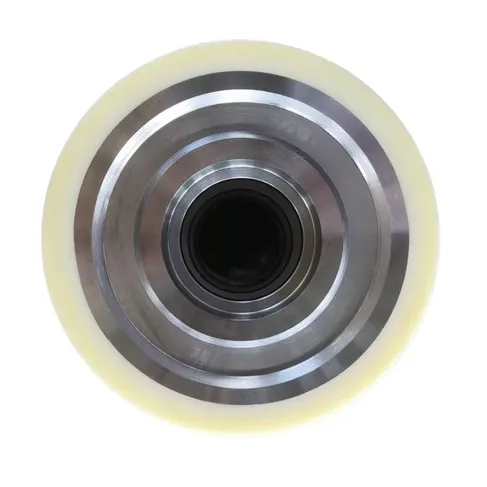
Targeting polyurethane’s weaknesses, our MC Nylon-Steel Core Wheels deliver full-scenario performance breakthroughs through material innovation and structural optimization:
1.Superior Energy Efficiency: The rolling resistance coefficient of MC nylon-steel core wheels is no more than 0.03, compared to 0.05-0.07 for polyurethane-iron core wheels. This translates to an 18%-28% reduction in energy consumption, with each AGV saving over 2.4 kWh of electricity per day.
2.Unmatched Load Capacity: Each MC nylon-steel core wheel supports a maximum load of 50,000kg—double the limit of polyurethane-iron core wheels (≤25,000kg per wheel). This represents a 100% improvement in heavy-load adaptability, with zero risk of permanent deformation even under extreme loads.
Wide Temperature Tolerance: Operating seamlessly between -43℃ and 126℃, MC nylon-steel core wheels outperform polyurethane alternatives (limited to -20℃~85℃). They maintain structural integrity without brittleness in -43℃ cold chain environments or softening in 126℃ high-temperature workshops, with a low-temperature impact strength of 20kJ/m².
Exceptional Wear & Corrosion Resistance: According to DIN 53516 testing, MC nylon-steel core wheels have a wear rate of ≤80mm³—far lower than polyurethane’s ≥200mm³. This extends service life to 24-36 months (2-3x longer than polyurethane’s 6-12 months) under 24/7 operation. Additionally, they resist oil, weak acids, alkalis, and metal chips, reducing failure rates by 90% in contaminated environments—unlike polyurethane, which is vulnerable to strong acids and oxidants.
Dimensional Stability & Structural Reliability: With a water absorption rate of ≤1.5%, MC nylon-steel core wheels maintain precision deviations of ≤0.1mm even under temperature and humidity fluctuations, making them ideal for high-precision 7th axis rail guidance. The integral casting process ensures seamless fusion between the nylon layer and steel core, achieving an adhesion strength of 35MPa—nearly double that of polyurethane (18MPa)—eliminating delamination entirely. Nano-reinforced modification further enhances performance, with a Shore D hardness of 82 and compressive strength ≥120MPa, resulting in deformation ≤0.5mm under 30,000kg loads. The self-lubricating property also reduces bearing wear by 40% without the need for additional lubrication, even in metal chip-rich environments.
III. Why MC Nylon-Steel Core Wheels Are The Optimal Solution for Heavy-Duty Automation
1.Precise Adaptation to Extreme Working Conditions:
Heavy Loads: The 50,000kg per wheel capacity covers all needs from logistics warehousing to heavy manufacturing, doubling the upper limit of polyurethane wheels;
Extreme Temperatures: No brittleness at -43℃ or softening at 126℃—solving polyurethane’s "hot-cold failure" dilemma;
Contaminated Environments: Resistance to oil mist, chemical corrosion, and metal chip erosion minimizes replacement frequency and reduces maintenance costs.
2.Total Cost of Ownership Advantage:
Energy Savings: Based on 16 hours of daily operation per AGV, annual electricity savings reach 876 kWh, translating to over €1,800 in annual cost reduction at industrial electricity rates;
Extended Lifespan: 24-36 months of service life (2-3x longer than polyurethane’s 6-12 months) reduces replacement frequency by 67%;
Downtime Reduction: Failure rate drops from 15% (polyurethane) to 1.2%, saving over €15,000 per production line annually in downtime-related losses.
3.Customization Capabilities:
Customizable Solutions: Tailored to rail dimensions, load parameters, and environmental conditions with sample delivery within 7 days.
4.Real-World Applications:
An automotive welding line reduced AGV motor load by 20% and extended wheel replacement cycles from 8 to 30 months after adopting MC nylon-steel core wheels, saving €27,000 annually in maintenance costs;
A -35℃ cold chain warehouse completely eliminated polyurethane wheel brittleness and cracking issues, reducing equipment failure rates from 22% to 0.8%.